
How to Search Cases by Name
Hawaiʻi's eCourt Kōkua gateway is the front door. Accept the disclaimer and finish the reCAPTCHA prompt when one appears. Party Search is the best start whenever the Maui County Case ID is unknown. Person searches need a first and last name. Middle name, filing dates, case type, Partial Search, and Phonetic Search can trim the results. For a business or agency, use Company Search instead. A shared name proves nothing. Two people can carry the same name. A case title may leave out a party named inside the file. So confirm the Second Circuit court, filing date, case type, and party role before you rely on the record.
- Open eCourt Kōkua and accept its terms.
- Choose Party Search and the person or company route.
- Enter the required name and known filters.
- Compare the court, parties, type, and filing date.
- Read Events and Dockets before treating the result as current.
| Route | Required | Refinements |
|---|---|---|
| Person | First and last name | Middle, phonetic, partial, dates, type |
| Company | Entity name | Phonetic, partial, dates, type |
| Party ID | Party ID | Dates and type |
Maui County Search Tabs Compared
eCourt splits its searches into Party, Vehicle, Case, Filing Date, and Upcoming Court Hearings tabs. A citation number might land in Case Search. A plate or VIN goes to Vehicle Search. Hearing Search answers a calendar question, but it is no substitute for the full court docket. Filing Date Search demands more: court type, court, location, room or division, case type, and the dates. Its interval cannot exceed 60 days.
| Need | Route | Starting key |
|---|---|---|
| Named party | Party | Person or entity name |
| Traffic matter | Vehicle or Case | Plate, VIN, citation, or ID |
| New filings | Filing Date | Court, type, and dates |
| Setting | Upcoming Hearings | ID or island and courtroom |
A results screen shows 20 rows by default. Set Show to a larger count and 200 records load per batch, with Load More pulling the next one. Printable View is available for filing and hearing results.
How to Search by Case Number
A known Case ID is the strongest key for a Maui County case lookup. Modern JIMS identifiers open with a circuit digit, then a court indicator, a two-character type, a two-digit year, and a seven-digit sequence. Maui matters start with 2. Leading zeroes in the last segment may be dropped. Older IDs sometimes need conversion first. The Judiciary's own examples turn FCCR-15-1-1234 into 2FC151001234, SC-16-1-456 into 2SC161000456, and DV-00-0-7128 into 2DV000007128. When an old number fails, suspect the format. The Case screen also takes application, arrest, TCT, OTN, and SID numbers, though the current manual names Case ID as the minimum on its Case ID route.
Maui County Legacy ID Fixes
Hawaiʻi moved older traffic data from TRAVIS to JIMS and swapped CourtConnect for eCourt in 2010. The official CourtConnect FAQ spells out record coverage and the limits of legacy numbers. That page is the place to check before puzzling over an old Maui County court docket number.
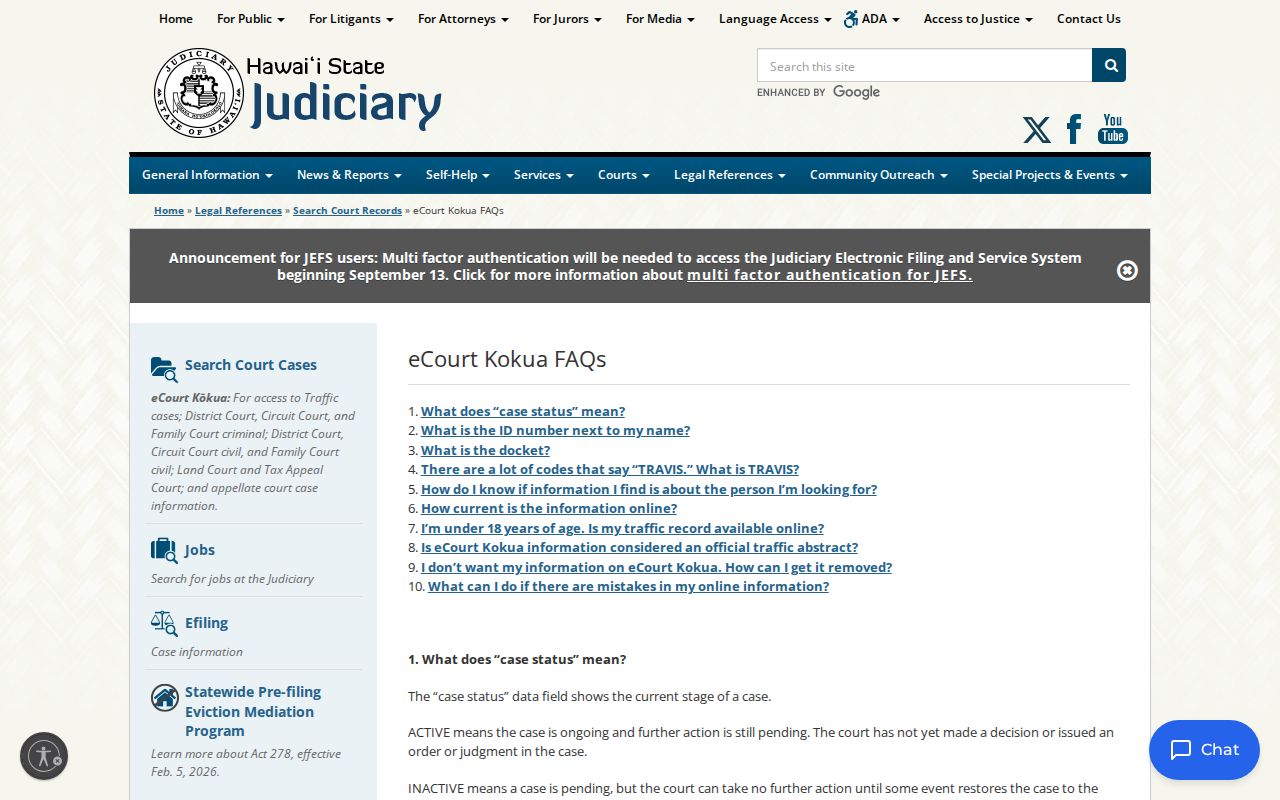
The coverage notes tell you why number conversion or a call to the clerk often beats repeated broad name searches.
What a Case Search Shows
Open a public Maui County result and several tabs appear. Summary gives the Case ID, type, status, last update, filing date, court, location, related cases, parties, and bail or bond when relevant. Case Parties lists sequence, role, party ID, names or aliases, and an "Assoc" link tying counsel to client. Events shows past and future settings in reverse order. Dockets holds dated filings and minutes. Offenses shows up only in criminal matters.
| Summary | ID, status, court, location, and filing date |
|---|---|
| Parties | Roles, IDs, names, aliases, and counsel links |
| Events | Completed and future settings, newest first |
| Dockets | Filings, minutes, actions, and PDF icons |
| Offenses | Criminal charge information |
A PDF icon means the image can be bought online. No icon does not prove sealing. The paper may still sit at the counter or require a request. Settings can change. Confirm any hearing with the newest filed notice.
Maui County Events Run Backward
The Events list on a Maui County docket runs newest first. Code CHD flags a change of court date. CON means the hearing was continued. Both are history. An older continuance sitting lower on the page can look current. Treat any entry past the top as background rather than the live setting.
- Event
- A scheduled or completed hearing, setting, or disposition.
- Docket entry
- A dated filing, minute, or court action.
- Status
- The system state, such as active, inactive, or closed.
- PDF icon
- A purchasable public image exists online.
Work top to bottom and open the newest notice first. If the hearing date itself is what matters, lean on the Maui County court dates process instead of the Events trail.
County vs Statewide Case Search
Maui County runs no docket portal of its own. Hawaiʻi’s unified Judiciary keeps Circuit, District, and Family Court records in one statewide system called JIMS, and the public reaches it through eCourt. Hoapili Hale serves as the local file hub, yet it holds no competing county database.
| eCourt Kōkua | Second Circuit clerk |
|---|---|
| Free statewide docket search | Paper, older, certified, and off-site records |
| Summary, parties, events, dockets | Counter, phone guidance, written request |
| Paid PDF when icon appears | Records without an online image |
JEFS plays a different role. It serves registered filers and their counsel, while everyday case lookup stays in eCourt. The official filing page spells out that boundary.
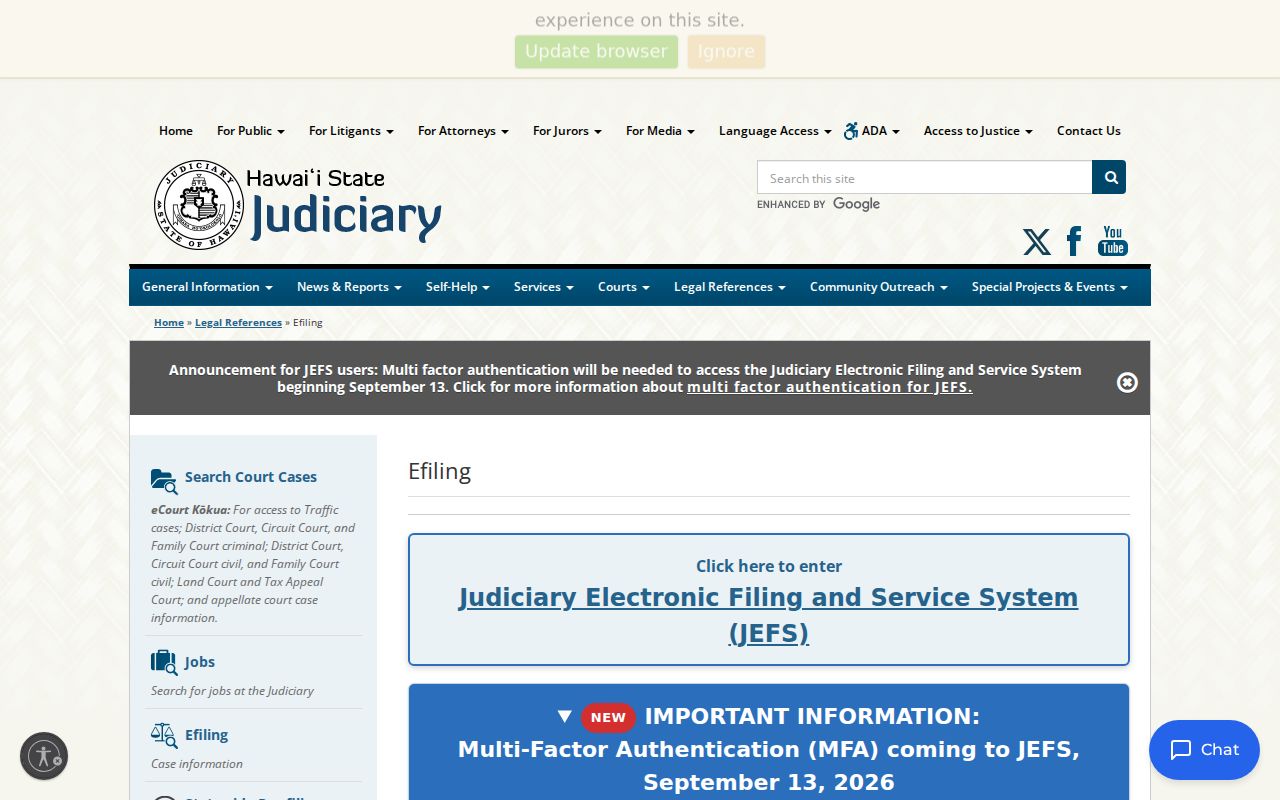
That boundary keeps a filing workspace from being mistaken for the public Maui County docket.
Maui County eCourt Access Hours
Plan searches around the schedule. eCourt runs Monday through Saturday from 4 a.m. to midnight HST. Sunday hours run from noon to midnight. Desktop browsers get official support. Mobile may work, with limited help behind it. Portal assistance waits at 808-539-4909. Email pao@courts.hawaii.gov on weekdays from 7:45 a.m. to 4:30 p.m. The official availability page posts current access details.
That posted schedule gives you a sound reason to retry later if the system sits outside its service window.
Restricted Cases and Access Rules
Confidential, juvenile, and sealed cases do not show up in eCourt at all. Even when a Maui County docket is visible, sealed or in-camera entries inside it stay masked from view. Hawaiʻi Court Records Rules hide protected personal and account data the same way. Adoption files are sealed. Covered juvenile dockets, filings, transcripts, findings, judgments, and orders face strict statutory limits on who may see them.
A blank search is not a legal finding. It can reflect a restricted case, old ID, omitted party in the title, wrong filter, or public paper available only at the counter.
HCRR Rule 10 keeps courthouse access open during business hours. A law, rule, or court order must close a record first. Requests can be oral, written, or electronic. They should name a party, any known case number, the case type, and the filing court. When a Maui County public file sits offline, ask the right Second Circuit clerk. You can also send Form 2D-P-332. For paper and certified copy routes, the Maui County court record search walks through them.
Maui County Purchased Documents
The docket search itself costs nothing. Downloading is different. A file-stamped PDF from a Maui County public file runs $3 per document or ten cents per page, whichever is greater. Electronic certification adds $2. Pick Regular or Certified, drop the item in the cart, give contact details, and pay.
Keep the emailed Purchase ID handy. Together with your email address, it retrieves the file for two days. The official retrieval guide spells out that window. If an icon is missing, the clerk handles the request. That quirk does not make the filing confidential.
Offline Maui County records take a bit more planning. Write down the exact document title and its filing date. Legal Documents at Hoapili Hale handles Circuit Court requests. District and Family Court clerks manage their own court records. Free terminals at the courthouse work too. Form 2D-P-332 covers selected papers, certified copies, older media, and off-site material. Files older than five years may sit away from the counter, so call first. The docket still names the filing even when it cannot hand you the document.
Note: Save a purchased Maui County document promptly. Reading the email late does not extend the retrieval period.